Do Adults Really Need Orthodontic Treatment? A Clinical Guide for Boston Adults
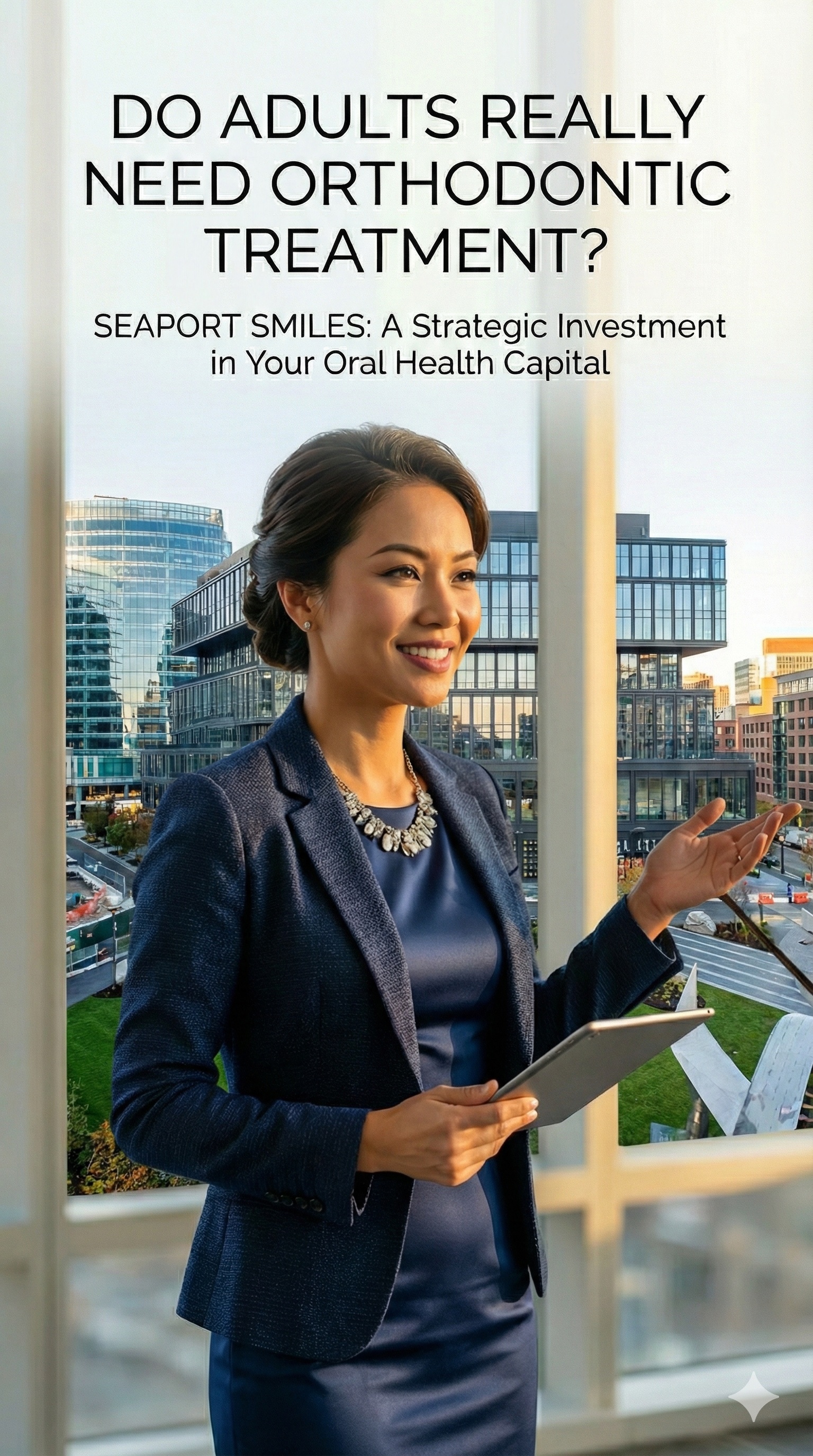
When Orthodontic Treatment Is Functional — Not Just Cosmetic
Short Answer:
Many adults do need orthodontic treatment — not only for appearance, but to protect teeth, bone, and long-term oral health. Adult orthodontic treatment can improve bite function, reduce wear, stabilize periodontal health, and make restorative dentistry more predictable.
Who This Is For:
Adults ages 28–65 in Boston who are wondering whether orthodontic treatment is necessary, elective, or preventative.
Why It Matters:
Tooth position affects bone levels, force distribution, wear patterns, hygiene access, and long-term tooth survival. What seems cosmetic at 35 can become restorative at 55.
What Does "Do Adults Really Need Orthodontic Treatment?" Actually Mean?
When adults ask, "Do adults really need orthodontic treatment?" they are usually asking whether orthodontics is medically necessary or simply aesthetic.
Orthodontic treatment is the controlled movement of teeth within bone to improve alignment, bite relationships, and functional balance. In adults, this is not about growth modification — it is about optimizing existing structures.
Biologically, teeth sit in living bone that remodels in response to force. Functionally, misaligned teeth can create uneven pressure, excess wear, gum recession, and difficulty cleaning. Over time, these small inefficiencies compound.
The long-term prognosis of teeth is directly influenced by how forces are distributed across them. Proper positioning reduces destructive stress and supports periodontal stability.
Why Adult Orthodontic Treatment Is Increasing in Modern Dentistry
Adult orthodontic treatment is one of the fastest-growing segments in dentistry. According to the American Association of Orthodontists, adults represent a significant and growing portion of orthodontic patients, and orthodontic care can help prevent or improve periodontal problems, reduce further bone loss, improve restorative outcomes, and enhance function.
Modern dentistry is interdisciplinary. Teeth are not treated in isolation. Position affects:
Periodontal healthImplant placementCrown marginsOcclusal force distributionFacial balance
Today, more restorative dentists are referring adults for pre-restorative orthodontics before crowns or implants are placed. The reason is simple: alignment first, replacement second.
Invisalign Boston patients frequently seek consultation not because something hurts, but because their dentist flagged wear, recession, or implant planning concerns.
Can Adult Orthodontic Treatment Help Avoid Implants, Extractions, or Extensive Crowns?
Short Answer: Sometimes. In selected cases.
Redistributing Occlusal Forces
Correcting deep bites or crossbites reduces excessive stress on specific teeth, decreasing fracture risk.
Creating Space Orthodontically
Instead of grinding adjacent teeth for crowns or bridges, space can sometimes be created or redistributed conservatively.
Uprighting and Repositioning
Tipped teeth next to missing spaces can often be uprighted, improving implant positioning and long-term biomechanics.
Orthodontic treatment does not replace restorative dentistry. It often improves the prognosis of restorative treatment by positioning teeth ideally before irreversible procedures are performed.
Think of orthodontic treatment—braces or Invisalign—like rotating your tires or changing your oil. You don't wait until the engine seizes or the tread is gone. You perform scheduled maintenance proactively because it's cheaper and more effective than catastrophic repair.
Similarly, repositioning teeth to where they ought to be before they fracture, before bone is lost, or before restorative work becomes inevitable is preventative dentistry. The cost and invasiveness of early intervention is always less than the cost of managing the consequences of neglect.
Clinical Situations Where Adult Orthodontic Treatment May Improve Tooth Survival
The AAO identifies several adult problems that may benefit from orthodontic correction. Below are common scenarios seen in adult patients.
Extensive Anterior Tooth Wear
Problem:
Deep bite or bruxism patterns lead to worn lower incisors (bottom front teeth) and chipped, fractured edges. Over time, this wear accelerates and can expose the nerve, requiring root canals or extractions.
Orthodontic Solution:
Intrusion or bite opening redistributes force and reduces destructive contact. By creating proper overlap and spacing, damaging forces are minimized.
Why Prognosis Improves:
Restorations placed on a corrected bite last longer because forces are more balanced. Without correction, new restorations will fail just as quickly as the original teeth.
Reduced Vertical Dimension
Definition:
Loss of height between the upper and lower jaws due to wear. This often occurs gradually over decades and is sometimes called "bite collapse."
Biomechanics:
When vertical dimension collapses, lower anterior teeth absorb excessive load. This creates a destructive cycle of wear, collapse, and further wear.
Orthodontic Role:
Bite correction can help re-establish proper spacing before restorative buildup.
Lack of Bone for Implants
Problem:
Bone volume appears insufficient for implant placement. Many patients are told "you don't have enough bone" and assume implants are impossible.
Orthodontic Principle:
Tooth movement stimulates bone remodeling and can improve alveolar architecture. In select cases, it can create bone where none existed, allowing for implant placement.
The Science:
Orthodontically induced bone generation has been documented in interdisciplinary treatment planning and can sometimes improve implant site conditions before surgery. This happens because bone follows teeth—where teeth move, bone develops.
Tipped Teeth Before Implant Placement
Problem:
When a tooth has been missing for years, adjacent teeth tilt and drift. This creates poor angulation for implant placement and compromises adjacent tooth health.
Orthodontic Solution:
Uprighting creates ideal spacing and angulation. This straightens the foundation before the implant is placed.
Why It Matters:
Implants placed in uprighted, well-positioned sites have improved load distribution and longevity. Uprighted adjacent teeth have better cleansability, less decay at the gum line, and fewer gingival issues (gum disease).
Periodontal Concerns and Crowding
Problem:
Crowded teeth are difficult to clean and contribute to gum inflammation. Persistent plaque and tartar accumulation causes bleeding gums in the short term and periodontal disease in the longer term, which significantly compromises tooth health and often results in tooth loss.
What the Research Shows:
The AAO notes orthodontic treatment can help prevent or improve periodontal problems and reduce further bone loss. When teeth are properly aligned, cleaning becomes more effective.
Orthodontic Solution:
Alignment improves hygiene access and redistributes force. This creates a healthier environment for gums and bone, reducing inflammation and preventing disease progression.
Biological Principle: Why Moving Teeth Changes Bone and Function
Orthodontic movement works because bone is dynamic. Unlike static structures, bone constantly remodels itself in response to forces placed upon it.
The Remodeling Process
When controlled force is applied:
Bone resorbs on the pressure sideBone forms on the tension sidePeriodontal ligaments adapt
This remodeling process allows teeth to move safely within bone while maintaining vitality. The process is gradual, controlled, and respects biological limits.
Why Force Distribution Matters
Correcting alignment also redistributes occlusal forces. When forces are balanced:
Teeth experience less traumaBone levels stabilizeRestorations last longer
Orthodontics is fundamentally a bone and force management discipline. By controlling where forces are applied and how they're distributed, we can preserve tooth structure and bone for decades.
Orthodontic Dentistry vs. Extraction and Replacement: A Comparison
| Approach | Focus | Invasiveness | Long-Term Tooth Preservation |
|---|---|---|---|
| Extraction & Implant | Replace missing structure | Surgical | Removes natural tooth |
| Orthodontic Treatment | Optimize existing teeth | Minimally invasive | Preserves natural tooth |
The Conservative Philosophy
Orthodontics is reversible and conservative. Once a tooth is extracted, it cannot be replaced biologically. While implants are an excellent solution for missing teeth, natural teeth—when they can be preserved—have advantages:
Natural proprioception (sense of pressure and position)Biological attachment to boneAbility to move and adaptNo risk of implant failure or peri-implantitis
Frequently Asked Questions About Adult Orthodontic Treatment
Is orthodontic treatment the same as cosmetic orthodontics?
No. Cosmetic orthodontics focuses on appearance. Adult orthodontic treatment often addresses function, periodontal health, and long-term tooth preservation.
Can orthodontics really improve bone levels?
Yes. Orthodontic tooth movement stimulates bone remodeling. The pressure from an orthodontic appliance—Invisalign or brackets and wires—stimulates the ligaments around the teeth, and those stimulate various bone cells to develop and facilitate tooth movement.
In interdisciplinary cases, repositioning teeth can improve bone architecture and periodontal conditions. This is not just theory—it's documented in clinical studies and observed in practice daily.
Is orthodontic treatment appropriate for adults over 50?
Absolutely. In many cases, it is especially relevant due to wear patterns, restorative needs, and bite instability. Bone continues to remodel throughout life, making orthodontic treatment possible at any age.
The biological processes that allow tooth movement don't stop at 50—or 60, or 70. What changes is the clinical approach and timeline, but the fundamental principles remain the same.
Will insurance cover adult orthodontic treatment?
It depends. Coverage varies based on:
The insurance plan itself
The details your employer selected during the company's group plan purchase
The plan that was selected when the subscriber signed up
Diplomatically stated, insurance is "tricky." That's why Dr. Ella Osborn and her team developed a questionnaire to help you navigate the nuances of orthodontic insurance benefits so you can find out exactly what the insurance plan will pay for.
Today, many adult plans provide a lifetime maximum, making orthodontic treatment even more accessible and affordable. Use this free form to maximize your insurance benefits—this is designed to help you and there is no obligation to submit any private information.
Who Should Consider an Orthodontic Consultation?
An orthodontic consultation may be beneficial if you are:
An adult told they need multiple crownsA patient recommended for implantsAn individual with worn or fractured teethA patient with a collapsed or deep biteAn adult noticing gum recession with crowdingA patient seeking specialist-level evaluation for complex interdisciplinary casesAn individual with fillings or crowns that are frequently chipping
The Boston Advantage
Boston patients have access to some of the most advanced interdisciplinary dental care in the country. Many general dentists in the Greater Boston area work closely with orthodontists to provide comprehensive treatment planning that prioritizes long-term tooth preservation.
The Interdisciplinary Approach: Orthodontics as Tooth Preservation Medicine
Before removing or replacing a tooth, it is reasonable to ask:
Has repositioning been considered first?
This question reflects a fundamental shift in how modern dentistry approaches tooth loss and restoration. Rather than defaulting to extraction and replacement, interdisciplinary teams now evaluate whether teeth can be preserved through orthodontic repositioning.
Function Over Vanity
For adults considering comprehensive dental treatment, the answer to "Do adults really need orthodontic treatment?" depends not on vanity—but on whether long-term tooth preservation and function are priorities.
If your goal is to keep your natural teeth functioning optimally for as long as possible, orthodontic treatment may be an essential component of your dental health strategy—not an optional cosmetic enhancement.
Making the Decision
Current tooth position and alignmentYour patterns and risk factorsRestorative needs and timingLong-term prognosis with and without orthodontic interventionYour personal goals and priorities
In Boston and surrounding areas, interdisciplinary consultation is readily available and can provide clarity on whether orthodontic treatment is right for you.
Related Articles

Conservative TMJ Treatment: Non-Surgical Relief for Jaw Pain
<h2>Evidence-Based Palliative Therapy for Temporomandibular Joint Dysfunction</h2>...
Orthodontic Dentistry: Can Moving Your Teeth Help You Save Them?
<h2>A Conservative Alternative to Extractions, Implants, and Aggressive Restorative Dentistry</h2>...
Ready to Start Your Smile Journey?
Schedule a consultation with Dr. Osborn and discover how we can transform your smile.
Book a Consultation